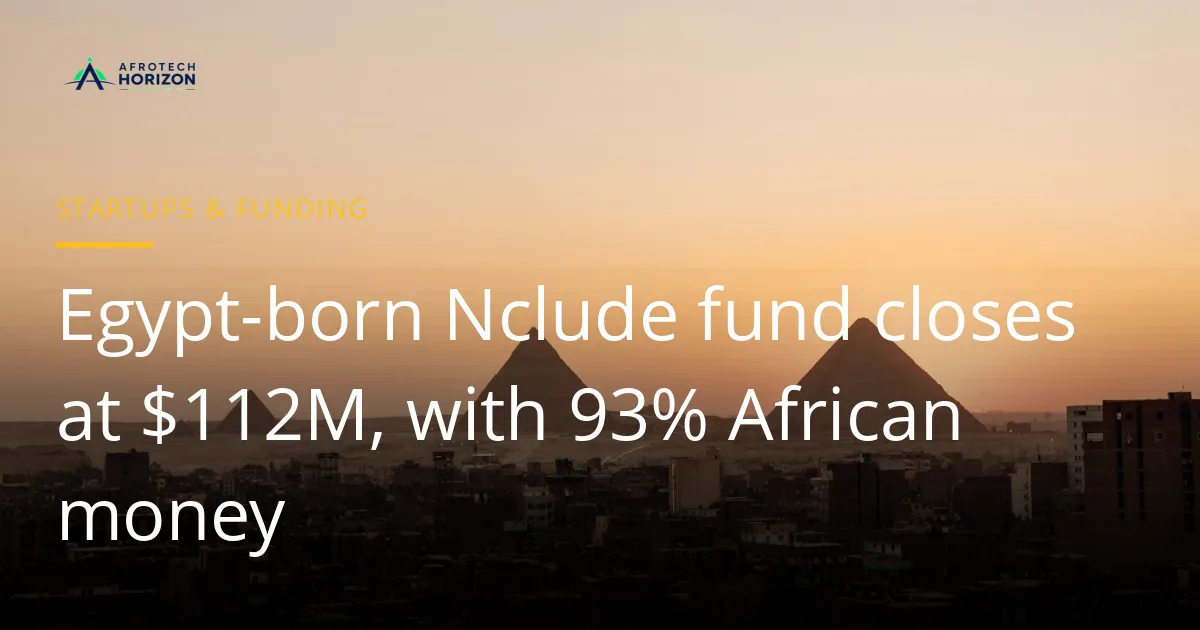
The Nclude fund, an Egypt-born fintech vehicle now advised by London-based DPI Venture Capital, has reached a final close of more than $112 million. Managing partner Ashley Lewis told TechCabal that about 93% of the commitments came from African investors, a share that is rare for a venture fund operating on the continent.
The announcement, dated 26 October, closes a chapter that began in Cairo in March 2022. It also gives Egyptian fintech founders a clearer picture of how much money is still on the table and what kind of companies will get it.
Who paid into the Nclude fund
The fund's backers are mostly Egyptian financial institutions. According to EnterpriseAM, which reviewed the fund's history, the limited partners include:
- National Bank of Egypt, with $30 million
- Banque du Caire, with $25 million
- e-Finance Investment Group, with $10 million
- Banque Misr, the anchor investor at launch
- Egyptian Banks Company, with an undisclosed amount
- Mastercard, which joined later in 2022
Empower Africa reported that financial services institutions accounted for almost all commitments, and that the fund was set up with support from the Central Bank of Egypt. DPI has brought in further investors since it took over, but none of the reports name them.
That mix explains the 93% figure. Most venture funds that invest in Africa raise the bulk of their capital from development finance institutions and investors in Europe and the United States. Nclude is close to the opposite: a fund paid for largely by the same domestic banks whose customers its startups are trying to serve.
From $85 million to $112 million
Nclude was launched in March 2022 at $85 million under Global Ventures, a Dubai-based firm. It reached $105 million at its second close later that year.
In April 2025, a restructuring handed investment advisory duties to DPI, which used the moment to launch DPI Venture Capital as its early-stage arm. DPI is an Africa-focused private equity firm with roughly $4 billion in assets under management and co-investments, according to EnterpriseAM.
At the time of that handover, the fund had invested more than $28 million across nine transactions, TechBooky reported. EnterpriseAM calculates that the final close adds roughly $7 million on top of the 2022 figure. The statement does not say how much of that came from new investors.
Lewis framed the size as a deliberate choice. "At over $112 million, we believe Nclude is appropriately sized for today's market," he said, as quoted by EnterpriseAM. In comments carried by Empower Africa he added that the amount "gives us the firepower to invest with discipline."
What the fund backs
The mandate has widened since launch. Nclude started out writing seed to Series B cheques. It now covers seed through Series C, with tickets from $500,000 to $10 million, according to Africa Private Equity News.
Key terms reported across the coverage:
- Egypt is the core market. Up to 30% of the fund can go to companies elsewhere in Africa and the Middle East.
- At least 10% of capital is reserved for seed-stage companies.
- The fund expects to hold 22 to 24 companies in total. It has 15 today.
- Targets include fintech firms, businesses that embed financial products in another service, and companies where AI and finance overlap.
The portfolio already reflects that spread. Named holdings include payments company Paymob, property platform Nawy, savings app Money Fellows, UAE-based SME lender FlapKap, Kera, a health-access AI company working in Senegal and Côte d'Ivoire, and Accord Partners, an AI-driven accounting roll-up focused on Saudi Arabia.
Why the 93% figure matters
African startups have spent years hearing that local capital would one day fill the gap left by cautious foreign investors. Pension funds and banks on the continent hold large balance sheets, but very little of that money has reached venture capital.
Nclude is one concrete case where it did, and the reason is specific. Egypt's banks have a direct commercial interest in fintech: payment rails, digital lending and savings products all feed back into their own businesses. A fund that gives them early access to that innovation is easier to justify to a board than a general technology fund.
There are limits to what the example proves. The money came overwhelmingly from one country's banking system, guided by its central bank. That model may be hard to copy in markets where banks are smaller or regulators are less involved. It is also worth noting that the jump from the second close was modest, which suggests the fundraising environment for 2026 has been slow even for a fund with strong domestic backing.
What founders should take from it
For Egyptian fintech founders, the main point is that a fund with a known appetite for Series B and C rounds is still deploying. With 15 companies held and 22 to 24 planned, there are roughly seven to nine new positions left, plus follow-on money for the existing portfolio.
For founders outside Egypt, the 30% allowance is the opening. Companies that can show a route into the Egyptian market, or that build financial products into health, property or business software, fit the stated strategy best.
For investors watching the continent, the close is a data point in a slow year. It shows that local institutions will commit when the strategy lines up with their own business. Whether that spreads beyond Egypt's banks is the question to watch.
For more on how African startups are raising money this year, browse our latest startup and funding coverage.